


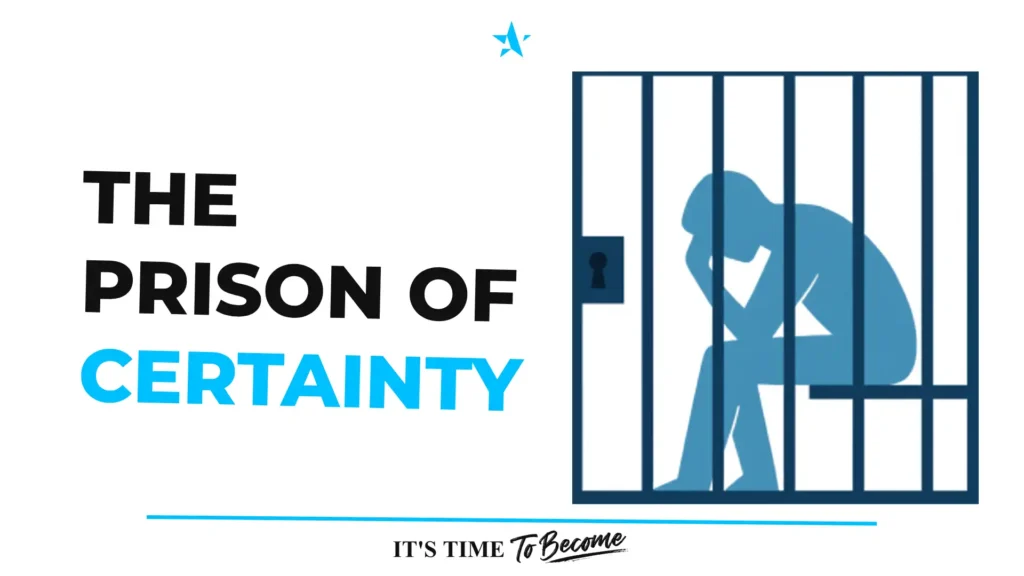
Have you ever noticed how the moment you become certain, you stop seeing?
Certainty feels like strength. It sounds like confidence. It looks like conviction. Yet beneath its calm surface, certainty often becomes a quiet prison.
Most people do not fail because they lack intelligence, effort, or ambition. They fail because they become trapped in what they think they already know.
The Comfort That Closes the Mind
Certainty is comforting. It removes tension. It simplifies the world. It allows us to say, I understand this, and move on.
But growth lives in tension.
When we are certain, curiosity shuts down. Questions feel unnecessary. New information feels threatening. Feedback sounds like noise rather than signal.
This is how learning stops.
In business, certainty shows up as rigid strategies, outdated assumptions, and leaders who confuse confidence with correctness. In life, it appears as fixed identities, unquestioned beliefs, and stories we refuse to revisit.
Certainty creates the illusion of control while quietly eroding adaptability.
How Certainty Becomes a Prison
The prison of certainty has no visible bars. Its walls are built from familiar thoughts.
This is how it forms.
First, an idea works. Second, success reinforces belief. Third, belief hardens into identity. Finally, identity resists change.
At that point, evidence no longer updates belief. It threatens it.
You stop asking, What is true now? and start defending what used to be true.
This is why once great companies collapse. Why talented people plateau. Why leaders lose relevance.
Not because they were wrong, but because they became certain.
The Psychology Behind It
The human brain rewards certainty. It reduces cognitive load and emotional discomfort. Ambiguity feels unsafe, even when it is necessary.
Certainty signals closure. But reality rarely offers closure. It offers patterns that evolve.
When certainty dominates, confirmation bias takes over. We search for proof, not understanding. We listen to respond, not to learn.
The mind trades exploration for protection.
The Alternative Is Not Doubt, But Humility
Escaping the prison of certainty does not mean becoming indecisive or insecure. It means holding beliefs lightly and updating them quickly.
The strongest thinkers are not the most certain. They are the most adaptive.
They replace rigid answers with better questions. They treat beliefs as working models, not permanent truths. They stay curious even when successful.
This is intellectual humility in action.
A Mental Model for Freedom
Think of certainty as a snapshot. Useful, but temporary.
Reality is a film, not a photograph.
If you cling to one frame, you miss the motion.
Progress requires the courage to say, This may no longer be true.
That single sentence keeps you free.
A Challenge for the Reader
Identify one belief you are most certain about.
Ask yourself three questions.
What evidence would change my mind? What am I not seeing because this belief feels settled? Who disagrees with me, and why?
Growth begins the moment certainty loosens its grip.
Final Thought
Certainty feels like clarity, but curiosity is what keeps us alive to reality.
The mind expands not when it knows, but when it is willing to learn again.
